

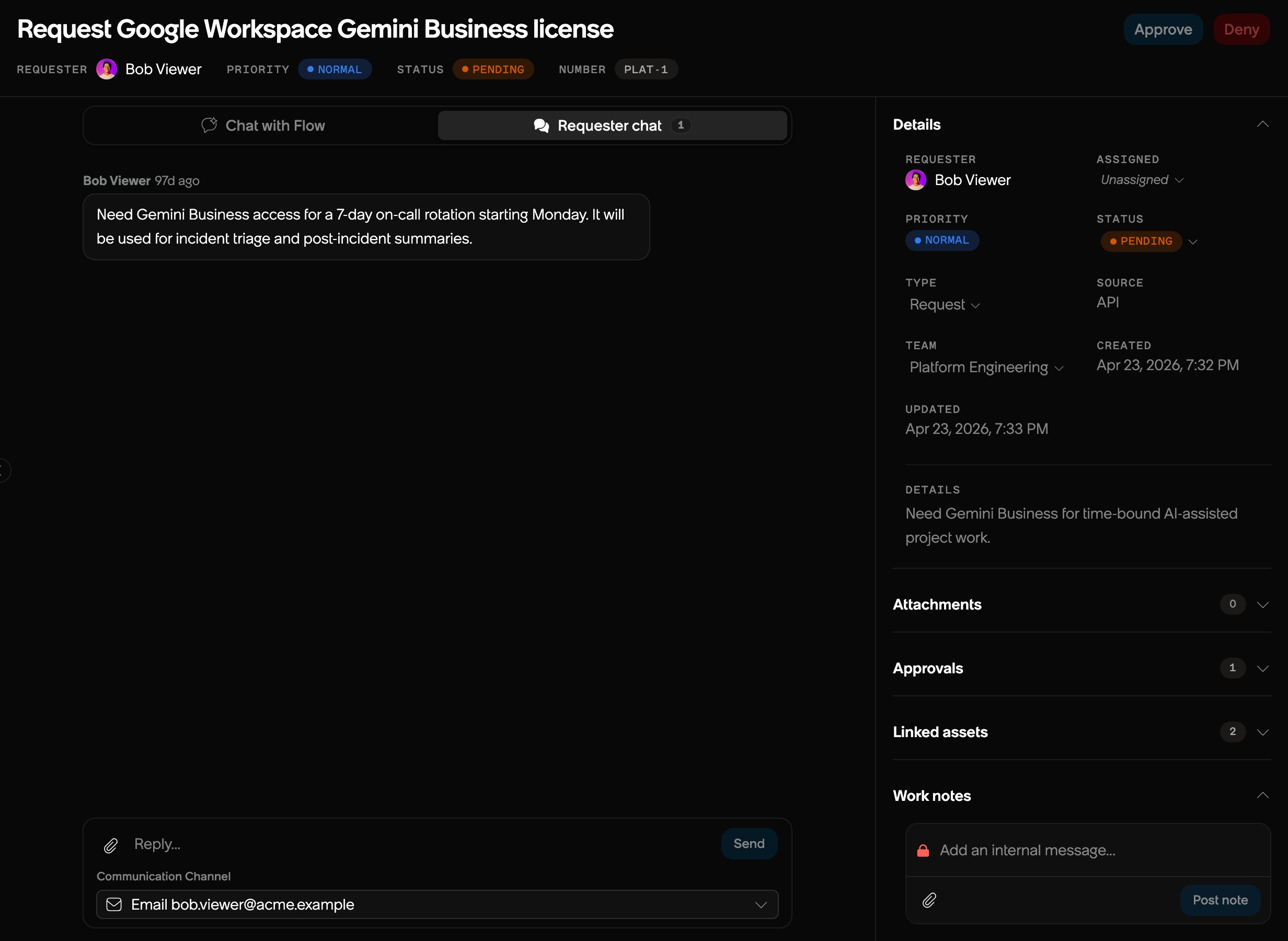
A request in Conversations, with Requester chat and the reply channel.
Tracking a request as a requester
Continue in the same place where the request started:- Reply in the existing Slack or email thread.
- In Flow, return to Home and continue the open conversation.
Existing software access
Flow checks for an existing license or unfinished access request before creating another allocation request. If a request is already in progress, check that request for updates. If access is being removed, contact the service team. If your existing access does not work, ask Flow to open a support ticket. Describe the problem, its impact, and any fixes you tried. The service team receives an incident to investigate instead of another license request.Adding files to a request
Files uploaded from the Attachments panel are added directly to the open request after Flow checks them. Files shared in a conversation with Flow are conversation context first, whether the conversation is in Flow or Slack. Sharing a file does not attach it to a request by itself. To add a conversational file to a request, explicitly ask Flow to add it. Name the file and include the request reference number when more than one file or request could match. Flow confirms the action only after checking the file, your access, and the target request. When you ask from the assistant inside an open request, the request details refresh after the attachment is added.Browser chat file support
When chatting with Flow from an open request, you can select up to 10 files for one message. Each file can be up to 25 MB. Flow accepts the following formats:- Documents and data: CSV, DOCX, JSON, Markdown, PDF, PPTX, TXT, and XLSX
- Images: GIF, JPEG, JPG, PNG, and WebP
- Audio and video: M4A, MOV, MP3, MP4, OGG, WAV, WebM
.xlsx file up to 10 MB. Flow reads visible and hidden worksheets, including
their names, cell positions, literal values, and saved formula results. It does not recalculate
formulas, fetch external references, or read charts and embedded media. Recognized calendar dates
appear as dates. When a date or time format varies by locale, Flow shows the stored serial and
labels a possible date. Other numbers use their stored values, so display formats such as
percentages, currency, times, and durations may differ from the spreadsheet app. If a formula
has no saved result, recalculate and save the workbook, or export the relevant worksheet as CSV.
Dense workbooks may show only part of each worksheet. Flow labels omitted cells. Upload a
smaller workbook or CSV when you need every row. Flow cannot read
encrypted or macro-enabled workbooks, or legacy .xls and .xlsb files.
Flow checks each selected file separately before sending the message. A Ready to send file stays
ready if another file needs attention. Upload interrupted means that you can select Send
again without re-uploading files that are already ready. If Flow cannot use a file, its status spells
out the reason, such as Larger than 25 MB or File type not supported. Remove that file before
continuing. Your draft and the other selected files stay in the composer while you recover.
Slack and email apply their own attachment count and size limits. The same supported file formats
and file checks still apply.
For PowerPoint files, Flow reads slide text, tables, links, and authored image titles and
descriptions from presentations up to 10 MB. Flow does not interpret slide images. Speaker notes,
SmartArt, charts, and embedded objects are not included. If the deck has no extractable text or
links, upload a text version or share the relevant slides as images. Use an unprotected .pptx
file, not a macro-enabled presentation.
Track a request as an operator
1
Open the conversation.
From the Conversations page, select the conversation.
2
Read Requester chat.
Read Requester chat and any Work notes.
3
Choose a channel and reply.
Choose an available route under Communication Channel, then reply.
4
Update assignment or status.
Update assignment or status when needed.